

Olga Tobreluts
Where Meanings Collide
The idea for Where Meanings Collide was born one evening two years ago, when Ivan Plusch and I met in my studio in western Hungary. We found ourselves deep in discussion about abstractionists, and as we spoke, a series of conceptual parallels revealed themselves—parallels we felt compelled to explore through painting. Thus were born our first sketches.
As we pursued our dialogue, probing the abstract, the non-objective, and the non-figurative, new meanings emerged—meanings engendered, first and foremost, thanks to certain capacities cultivated by contemporary individuals.
Every era has birthed artists who entered the annals of history by engaging deeply with the technological advances of their time. The scientific achievements of the past—and the names behind them—may fade from humanity’s collective memory, but miraculously surviving works of art continue to testify to the secrets held by earlier civilizations. Among these are the masterpieces of Ancient Egypt, Ancient China, and Ancient Greece, as well as those produced during more recent eras.
The esoteric knowledge of priests and artisans—the secrets of their craft safeguarded by guilds and passed from teacher to student—facilitated the creation of works of tremendous emotional impact. The key lesson imparted to us by the old masters is this: we see not with our eyes alone, but with our eyes and our brains. Artists can therefore shape our apprehension of their works by embedding them with information that escapes our conscious notice, yet resonates deep within the subconscious.
Consider Johannes Vermeer. The extraordinary light in his paintings wasn’t merely the product of painterly genius—it was born of a friendship with Jacob Dissius, a printer fascinated by optics. Vermeer didn’t simply use the camera obscura; he developed painterly techniques that signal to the brain the presence of intense light on the canvas. One such technique involved arranging scarcely perceptible multicolored dots around patches of white, creating halo-like effects. What the eye fails to perceive, the brain cognizes, enriching the image with additional information. By marrying brushwork with optical science, Vermeer forged a seventeenth-century visual language that continues to captivate us today.
By the late twentieth century, it seemed as though abstraction had run its course—until the digital revolution upended everything. New technologies granted us unprecedented access to information, expanding not only what we know, but how we see.
In the late 1990s, the Petersburg-based artist Timur Novikov developed a theory he called “semiotic perspective,” accompanied by a body of work illustrating this idea. Modern individuals, he argued, possess internalized representations of virtually everything that exists. They do not need to be shown, in detail, what the North Pole looks like. A white field, a blue field, and the silhouette of a polar bear are sufficient to conjure the Arctic in the viewer’s mind. Imagination, memory, and experience transform schematic visualization into a three-dimensional scene: the white field becomes snow, the blue field sky, and the line between them the horizon.
Linear and aerial perspective no longer hold sway. The paradigms inherited from the Renaissance—which until relatively recently served as the fons et origo of our visual culture—have given way to something altogether new.
All twentieth-century experiments in abstraction can be seen as precursors to the coming merger of human consciousness with artificial intelligence. Cosmism, in pushing us beyond Earth-bound existence, demands an abandonment of familiar coordinates: solar time, lunar cycles, terrestrial gravity. If humanity is serious about settling other planets, it is only logical to expect radical transformations in art as well.
As I see it, these transformations will emerge from the intersection of traditional painterly techniques and the digital potential of artificial intelligence. This symbiosis may give rise to entirely new approaches and solutions. In my earlier project Transcoded Structures, I explored how a digitally rendered 3D image, translated onto canvas using traditional painting techniques, could be embedded with a code readable by digital devices. When pointed at the canvas, these devices automatically imbued the work with additional dimensionality.
Working on this project revealed an unwitting tendency on the part of the artist to enter into a back-and-forth dialogue with graphic software—a dialogue that persists on an unconscious level even after the software is set aside and the artist returns to paint and canvas. This ongoing exchange attests to a deeper symbiosis between human creativity and digital technology, one that transcends the immediate and direct use of software.
In the first part of our painterly dialogue, Ivan and I revisit the techniques artists have historically used to express emotions, ideas, and concepts through shape, color, and texture. As we pit these techniques against one another and generate new variations on old themes, we step, metaphorically, into the Mandelbrot set—tracing the history of abstraction to the limits of its possibilities, where established techniques are exhausted.
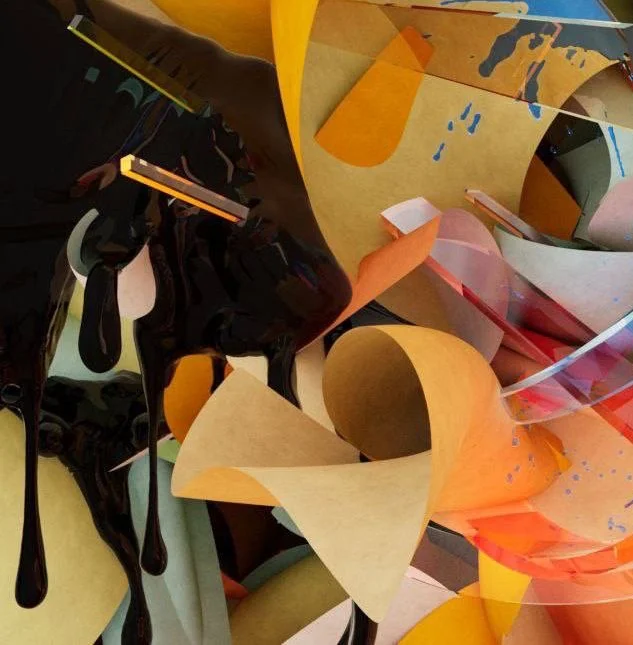
The installation culminates in a “dialogue of imagery”: abstract forms interacting in real time across dual screens. This back-and-forth exchange introduces an element of chaos, allowing abstractions to become unstable, to mutate, and to evolve in real time. From this instability arise new interpretive possibilities. The ever-shifting interplay of abstract elements generates countless novel and formally striking ideas.