

Ivan Plusch
Where Meanings Collide
In this project, we talk about the abstract, the non-objective, and the non-figurative. Yet, ultimately, all of this is about the human: the human’s current state and their way of seeing. The history of art is inextricably linked with history itself, and at pivotal historical moments abstract art has come to the aid of the human psyche.
Today, we decipher images far more quickly than before. The accelerating flow of information trains us, while simultaneously striving to merge reality and non-reality into a single stream. Within this mosaic of images, our attitude toward the familiar shifts depending on context, granting us an infinite number of “fields of options.”
In the course of our pictorial dialogue, the influence of the original works intensifies, transforming previously deciphered objects and images into something new, something not yet named. It is important that we chose these two media—digital video and the classical form of canvas painting—because the digital stream, a defining marker of our time, carries and transforms information presented as images, leaving only the brightest imprints both on canvases and in our consciousness.
The progress that occurred in the twentieth century across all spheres of life has now shifted onto another plane. In our time, it alters everyday life to a lesser degree, while more profoundly reshaping self-determination within society. It offers the possibility of a mask, the ability to live several lives at once, or to exist within multiple layers simultaneously. These layers act as masks that amplify digital noise, further blurring the boundary of corporeality. Attempts to renounce corporeality, in turn, lead toward abstraction, non-objectivity, and the non-figurative.
For me, this project continues an investigation into the new—digital—time that began in 2019. The After project examined transformations within the emerging landscape, as “machine” vision increasingly penetrates everyday life, reshaping the optics of all living beings and defining a vector that will extend for decades to come.
This project was created to study the balance between the physical and the digital, the real and the ephemeral.
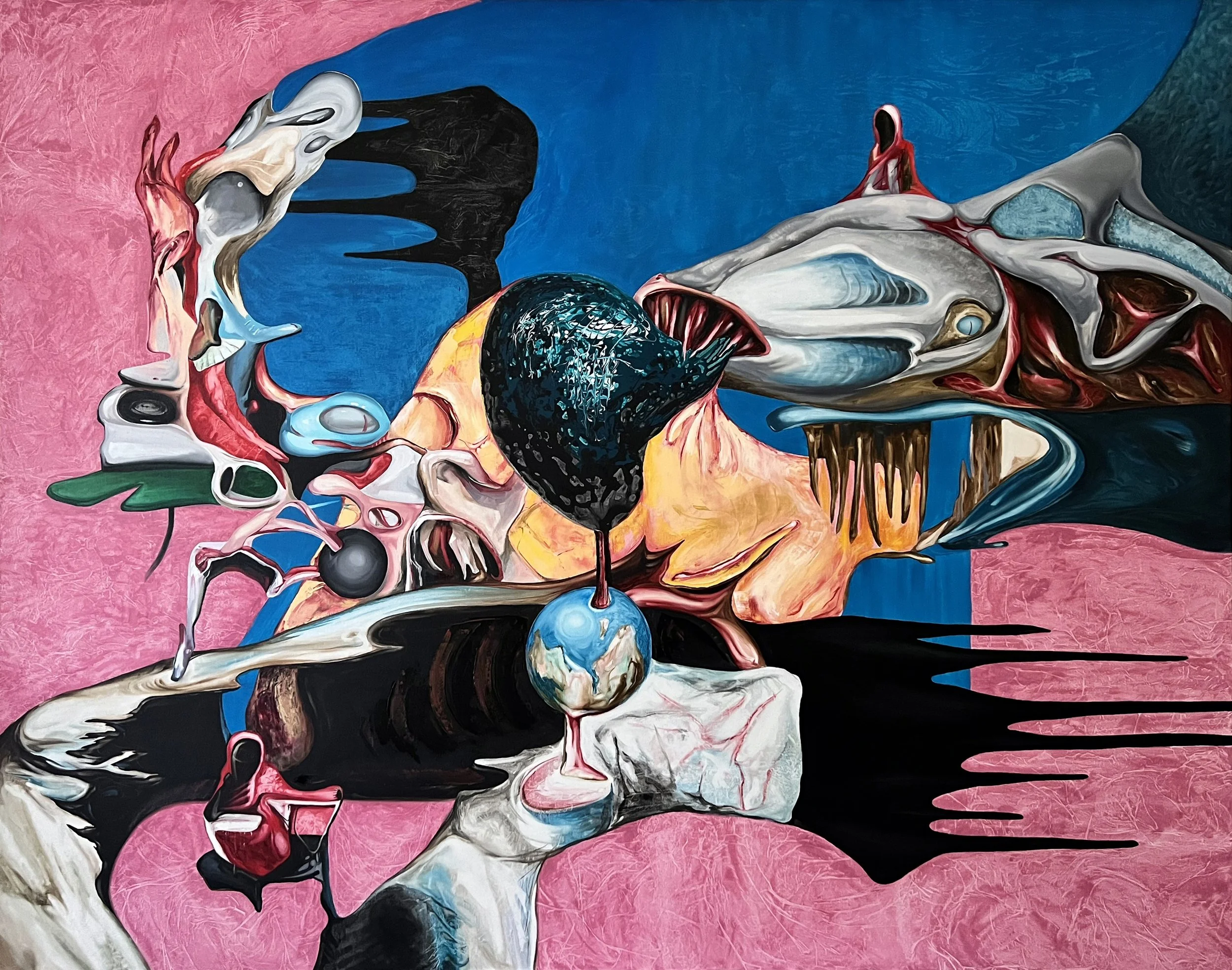
In essence, it proposes a new way of seeing the material world—one in which the flow of form is no longer an exceptional event, but an ordinary condition. Form freezes into a set of images, which I then develop through pictorial means. In parallel, I infuse these images with hints of objects encountered in daily life, experiencing—much like a neural network—apophenia: the recognition of another object within an image.
Ultimately, the project is an attempt to comprehend digital technologies and their aesthetics within everyday life, to visualize the existence of a world that has not yet been fully recognized or understood, and to explore a mode of thinking that operates according to its own canons and laws, detached from the sensation of the “alive.”